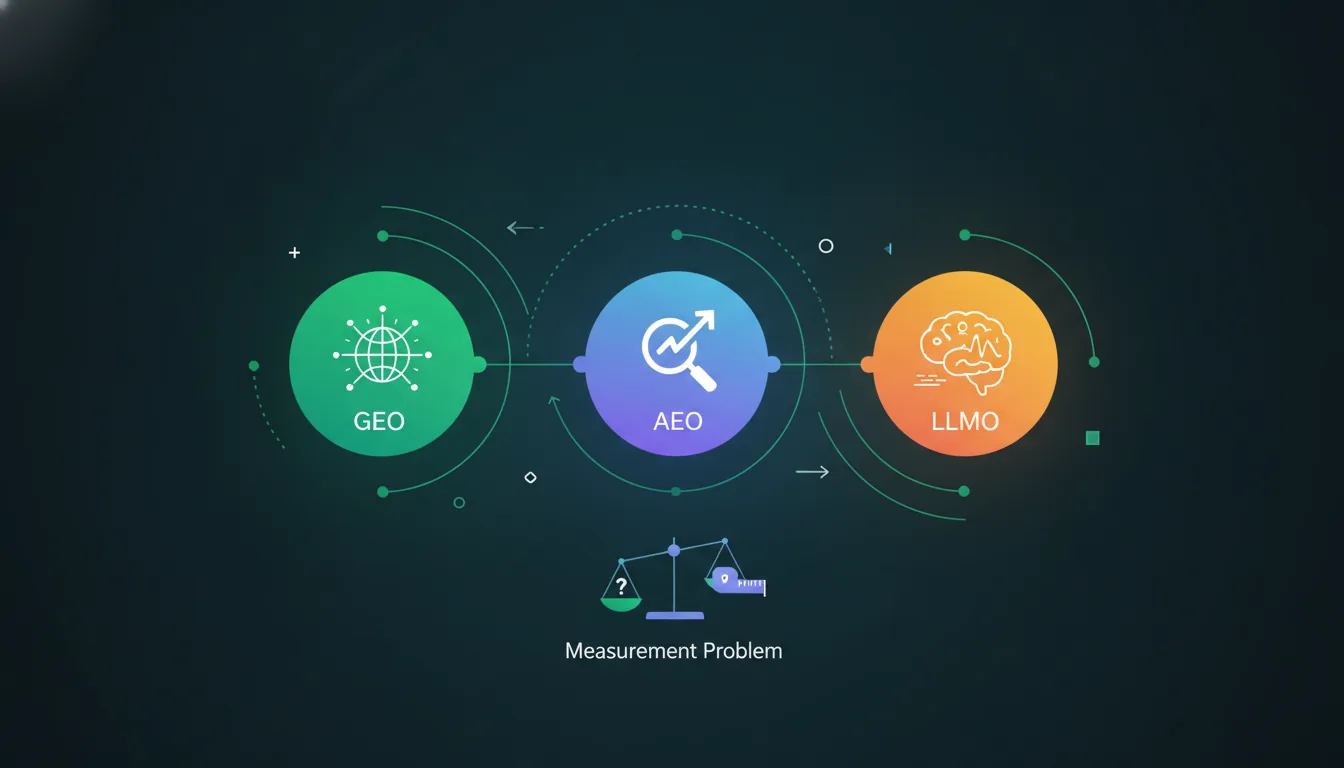
GEO, AEO, LLMO: Three Acronyms, One Measurement Problem
The industry invented three names for the same situation: AI answers name a few brands, and you do not know whether you are one of them. Here is what each label means.
Three acronyms are circulating for what is, underneath, the same problem. GEO. AEO. LLMO. They arrived within months of each other, some people use them interchangeably and others define them in mutually exclusive ways, and the only point of agreement is that you should probably be worried about it.
The short version, before the long one: they describe overlapping views of a single situation. Generative AI systems answer questions by naming a handful of brands, and most companies have no idea whether they are among them. Everything else is vocabulary.
What each one is actually claiming
GEO: Generative Engine Optimization
GEO is the term with the clearest origin. It came out of academic research, not a marketing agency, and it was coined to name a specific question: given that generative engines synthesize an answer rather than return links, what makes a source more likely to be used and mentioned in that synthesis?
The framing is about engines as systems: something that retrieves, ranks internally, summarizes, and emits prose. It covers ChatGPT, Claude, Gemini and Perplexity, plus the AI summaries stitched on top of traditional search. The unit of success is not a position. It is whether your name appears in a paragraph with room for only a few names.
AEO: Answer Engine Optimization
AEO is the older idea wearing new clothes. It predates the current wave of chatbots and originally described optimizing for featured snippets, voice assistants and anything else returning one answer instead of a page of options. Structured data, question-shaped headings, direct answers in the first sentence of a section. That was AEO before anyone had heard of a large language model.
Since then the label has been stretched to cover generative chat interfaces too, which is why it now sits awkwardly next to GEO. Read someone using AEO carefully and you can usually tell which of the two they mean: the schema-and-snippets version, or the models version. Often they mean both, without noticing these are different machines with different failure modes.
LLMO: Large Language Model Optimization
LLMO takes the narrowest and most literal aim: influencing what a language model itself says, as opposed to what a retrieval layer feeds it. The distinction is worth understanding, because it is the one place where these acronyms point at genuinely different mechanisms.
A model can answer you in two very different ways. It can answer from what it absorbed during training, in which case there is no live source, no citation, and nothing you published last week has any bearing on the output. Or it can answer from documents retrieved at query time, in which case what is on the open web right now matters enormously. Most systems do some of both, and they do not tell you which mode produced which sentence.
LLMO, taken literally, aims at the first mode, and the first mode is close to unaddressable. You cannot submit a page to a model's weights. You cannot edit what it learned. Whatever the acronym implies, nobody is optimizing a language model from the outside.
Why there are three of them
New categories generate vocabulary. That part is normal. What is worth noticing is the direction the vocabulary runs.
Each acronym ends in optimization. All three describe an intervention. None describes a measurement. That is a strange thing to build a discipline on, because the intervention side is precisely the part nobody can yet demonstrate they control, while the measurement side is available to anyone willing to look.
The honest state of play: we can observe, reliably, what generative systems currently say about a brand, which brands get named instead, and how that differs by platform and by language. What nobody can do is guarantee that a particular action changes any of it. The industry has produced three names for a method and almost nothing for the thing the method would need in order to work at all, which is a baseline.
A market that sells method before it has measurement is a market selling confidence. The acronyms are the packaging.
The one you have to disarm: GEO is not geography
This confusion is everywhere and it is worth stating flatly. GEO means Generative Engine Optimization. It does not mean geolocation, geographic targeting, map results, or local search.
The collision is accidental. "Geo" as a prefix has meant earth for a very long time, so an article titled "GEO strategy for your business" could plausibly be about either subject, and plenty of published material conflates the two. Some was written by people who did not check. Some was written by machines that did not know.
If something in this space starts talking about Google Business Profiles, opening hours or proximity radius, you are reading about local search. It is a real discipline. It is not this one. The two share nothing but three letters.
Under the labels, the problem is singular
Strip the vocabulary away and here is what is actually happening. Somebody asks an assistant which tool, supplier or product they should consider. The assistant does not return a list of everyone. It writes a sentence or two of prose and names a small number of companies. There is no second page, no "see more results". The brands left out did not lose narrowly. They were not in the conversation at all, and the person asking has no way of knowing they exist.
That is the entire problem, and no acronym changes it. So the questions you need answered are the same whichever word you use for the discipline.
- Does the system name you when someone asks the question your buyers actually ask, rather than the question that contains your brand name?
- Does it cite you, with a link, or merely mention you? These are different outcomes. A model can describe your product accurately and send you no traffic whatsoever, which is why analytics tools are structurally incapable of seeing this.
- Who gets named in your place? This is usually the most uncomfortable answer, because it is often not the competitor on your own market map. Models group brands by how the web talks about them, not by how you segment your category.
- In which language? Visibility does not cross borders. A brand an assistant recommends fluently in English can be missing entirely from the same question in German, because the German-language web says less about it. There is no single global answer to check.
What to do with that
You can test all four by hand, today, for free. Open a chat assistant, ask the question a prospect would ask before they know you exist, and read who gets named. Then ask again. The answer will not be identical, because these models are probabilistic and a single response is an anecdote rather than a finding. Then translate the question into each language you sell in and repeat.
Do that honestly and you will learn more in an afternoon than any acronym will teach you. You will also discover why it does not scale: the checks you need are prompts multiplied by repetitions multiplied by platforms multiplied by languages, and that grows faster than your patience.
That multiplication is the reason tools exist, and it is the part PSentry automates: running a prompt set across ChatGPT, Claude, Gemini and Perplexity, in every language and market you operate in, and reporting where you are named, where you are cited, and who is named instead of you.
Two limits stated plainly, because this article has just accused an entire category of overpromising. The tool behind that claim does not escape its own argument: it cannot manipulate a single word a model produces, and anyone who says otherwise owes proof they do not have. Nor does it watch in real time; it samples on a fixed twice-monthly rhythm, because a model's opinion of a brand does not flip between one morning and the next. What you get is a baseline. Given that the industry has produced three acronyms and no baseline, that seems like the correct order to do things in.
Frequently Asked Questions
Which acronym should I use when talking to my team?
GEO is the one with a traceable origin and the least ambiguity about what it refers to, so it is the safer default in a document that has to survive being read by someone else. Whichever you choose, define it in the first paragraph. Half your readers will assume you mean geography otherwise.
If nobody can prove an intervention works, is any of this worth doing?
Measuring is worth doing, because you cannot evaluate any intervention without a baseline, and the baseline is currently missing everywhere. The reasonable posture is to find out where you stand, keep publishing clear factual content about what you do, and stay skeptical of anyone who claims a lever.
Is AEO obsolete now that GEO exists?
Not obsolete, just older and narrower. The structured, direct, question-answering style of writing that AEO always advocated is genuinely easier for a model to reuse than dense positioning prose. That advice did not stop being sensible. It simply stopped being sufficient.
Why do the answers keep changing when I ask the same question?
Because language models sample from a distribution rather than looking up a stored result. The same prompt can produce different lists of recommended vendors on consecutive runs. This is not a defect you can tune away, and it is exactly why repetition, not a single check, is what separates a measurement from a guess.
Will a new acronym replace all three?
Possibly, and it will not matter. The underlying question stays the same in every version: when a machine answers on your behalf, does it say your name, and in which languages does it fail to.