
When an AI Confuses Your Company With a Namesake
Two firms, one name, and an assistant that has to pick. Why the less documented company loses, how retrieval merges the two, and what separates them.
Read moreHow AI answers talk about brands, and how to measure it
Two firms, one name, and an assistant that has to pick. Why the less documented company loses, how retrieval merges the two, and what separates them.
Read more
Article 50 of the AI Act applies from 2 August 2026. Your assistant now marks its text; whether your product pages need a label is another matter.
Read more
Google's generative search reached Britain, Germany, Italy, Spain and France years apart. For an exporter, that gap changes how any cross-market comparison reads.
Read more
Procurement suites now have agents that propose suppliers to buyers. Nobody outside can see what they say, but what they read is largely yours to fix.
Read more
Google Ads now infers language rather than asking for it. A five-step afternoon check of how your multilingual pages declare what language they are in.
Read more
Google now lets any site leave AI Overviews and AI Mode. For a supplier selling to engineers and buyers, the switch usually guards very little worth guarding.
Read more
Search Console now reports on AI Overviews and AI Mode for every site. It counts something real. It is not your AI visibility, and the gap is worth understanding.
Read more
ChatGPT now carries ads in 31 European countries. Being named by the model and being shown beneath it are two different events, and they should never share a figure.
Read more
Your catalogue has a name for what you sell. The person looking for it describes the job instead, and the assistant answers the description, not the label.
Read more
The question lands in a management meeting, gets passed to marketing, and stops there. The material that decides the answer belongs to a different department.
Read more
Past a certain point, extra measurement stops adding information and starts manufacturing movement. The fix is more repetitions per point, not more points.
Read more
Measure in the language of the market, obviously. Except your engineers research in English, your buyers do not, and the two get different answers.
Read more
A model has two ways of knowing anything: what it absorbed while training, and what it fetches while answering. Your launch only exists in the second one.
Read more
Your access log already knows which AI systems have read your site. Here is how to find them, and how to tell a training crawler from a live question.
Read more
Generative engine optimisation attracted the same sales patterns early SEO did. Six claims that cannot be true, and the questions that expose them.
Read more
The engineer asks about tolerances, the buyer asks about lead times, and the two questions retrieve different pages. Most industrial sites answer only one.
Read more
Buyers put certifications in their prompts. If yours live only inside a scanned certificate, the assistant will name whoever wrote them out as text.
Read more
A site redesign renames your catalogue URLs and the citations pointing at them quietly stop resolving. What breaks, what survives, and what to check first.
Read more
Retrieval is the difference between an assistant quoting your current catalogue and inventing a plausible version of it. Here is the mechanism, without the jargon.
Read more
Ask four assistants who can machine a part to your spec and you get four different supplier lists. The reasons are structural, and testable in an afternoon.
Read more
Most AI-visibility reports bury the one finding that matters under methodology and platform tables. Here is the structure that gets read.
Read more
A brand can appear in every AI answer for a category and still lose the sale if the tone is hedged while competitors get named with confidence.
Read more
AI models state wrong facts about companies with total confidence. Here is why it happens to brands specifically, and a way to check if it is happening to yours.
Read more
GA4 has no button labeled AI traffic. Here is how to isolate ChatGPT and Perplexity referrals yourself, and why the number you get will always undercount.
Read more
What has to be true, in writing, on the open web, before ChatGPT, Claude, Gemini or Perplexity puts your company's name in an answer about a technical capability.
Read more
Your tolerance tables and certifications might sit in a PDF no AI can actually read. Here's the exact test to check yours this afternoon.
Read more
Travelers now ask AI assistants to recommend hotels, not just find them on a map. Does your brand get named, in the languages your guests search in?
Read more
An AI assistant can only recommend a professional-services firm it can describe specifically, not one that merely has a polished website.
Read more
Procurement teams now start supplier searches with an AI prompt, not a directory. Here is what actually makes a manufacturer show up in that answer.
Read more
Translating a good prompt set into five languages produces five fluent, useless instruments. Here is how to author one that actually measures each market.
Read more
A regional supplier with dense local-language coverage can outrank a global leader whose local site is only a translation. Here is why, and how to check it.
Read more
Your brand shows up when a model answers in English and disappears when the identical question is asked in German. Here is how to check why yourself.
Read more
The same question in Spanish reaches different sources, different competitors and a different word for your product depending on the market. One score cannot describe both.
Read more
Your site speaks five languages and the models still ignore you in four of them. Translation moves your words. It does not move what other people say about you.
Read more
Open your robots.txt and look. Training crawlers and live retrieval fetchers are two different decisions, and most sites block both by accident.
Read more
An assistant recommending a vendor needs a verdict it did not get from the vendor. Here is why review listings get quoted, and what to check on yours today.
Read more
Before asking whether AI recommends you, ask whether it knows who you are. On ambiguous names, reference sources, and why you never write your own entry.
Read more
A model never watches your video. It reads the text around it. Which means a video without a clean transcript is, to a machine, almost mute.
Read more
Why a thread beats a landing page when a model looks for an answer, what you are allowed to do about it, and why anyone selling Reddit placement is selling manipulation.
Read more
One answer sits above the search results, the other happens inside a chat. They are not interchangeable, and a good score in one predicts nothing about the other.
Read more
Three Google surfaces get confused constantly, and the confusion sells the wrong tool. What actually separates them, and which one PSentry can see.
Read more
The same question, asked twice, gives two answers. That is not a bug and it is not your content working. It is sampling, and it changes how you measure.
Read more
Claude answers many B2B questions from what it learned in training, not from the live web. That changes what you can measure, and how you check it.
Read more
Gemini is an assistant, a model family, and the engine behind Google's search summaries. Only one of those is what we measure. How to check the right one.
Read more
No comparison table, no verdicts on products we have never used. A protocol you can run in a week, plus the checks that expose a weak tool. Apply it to us.
Read more
Two ways exist to ask a model your prompts, and they do not return the same answer. What changes in practice, and the question to put to any vendor.
Read more
The metric is decided by its denominator. Pick the competitor set yourself and you have picked the result; let the model pick it and it moves under your feet.
Read more
It is the only AI platform that prints the pages behind its answer. That makes it the best diagnostic instrument you have, and a poor proxy for everything else.
Read more
A diagnosis before a solution: the usual causes of AI invisibility, ordered by how often they turn out to be the real one, and how to check each yourself.
Read more
The honest split: the work that genuinely helps, the work that happens nowhere near your website, and the levers that do not exist at all.
Read more
Every answer these tools show you was bought from a model, one paid call at a time. That single fact explains every line on the pricing page, including the cheap ones.
Read more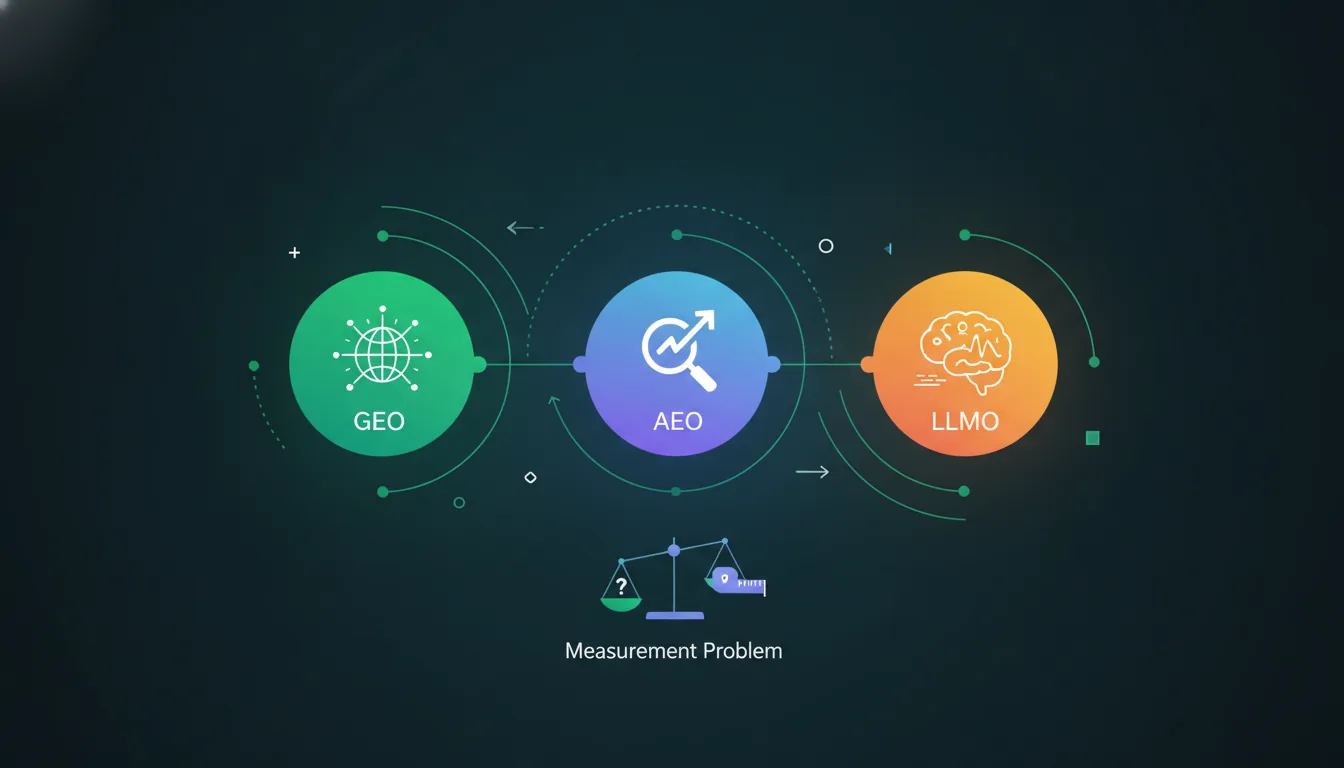
The industry invented three names for the same situation: AI answers name a few brands, and you do not know whether you are one of them. Here is what each label means.
Read more
The score is the least useful thing in your first report. Here is what a scan actually does, what it can tell you, and what no tool can promise.
Read more
No verdicts and no comparison table: the questions that separate a tool that measures from one selling you noise, and the sales answers that should worry you.
Read more
The same question, asked in German instead of English, returns a different answer with different brands in it. For exporters, that gap is the whole story.
Read more
Ask the four big AI assistants the same buying question and you often get four different brand lists. Watching only one of them measures a quarter of your visibility.
Read more
The useful data in an AI answer is not whether you are in it. It is who is there when you are not, and that list rarely matches your market map.
Read more
You can be named by ChatGPT all day and never see a click. That is not a failure. It is three different phenomena wearing one word.
Read more
In AI search the unit of measurement is not the keyword, it is the prompt. Pick the wrong ones and you measure nothing, pleasantly.
Read more
A step-by-step manual method to see whether AI assistants name your brand, the mistake that makes most DIY tests worthless, and the point where it collapses.
Read more
Asking ChatGPT what it knows about your brand always gives a reassuring answer, and it measures nothing. Here is the test that does.
Read more
A score compresses hundreds of AI answers into one number. Here is what survives the compression, and what quietly gets lost along the way.
Read more
Search gave you a list of ten links. An AI gives one paragraph with room for three names. You are no longer competing for placement, but for inclusion.
Read more