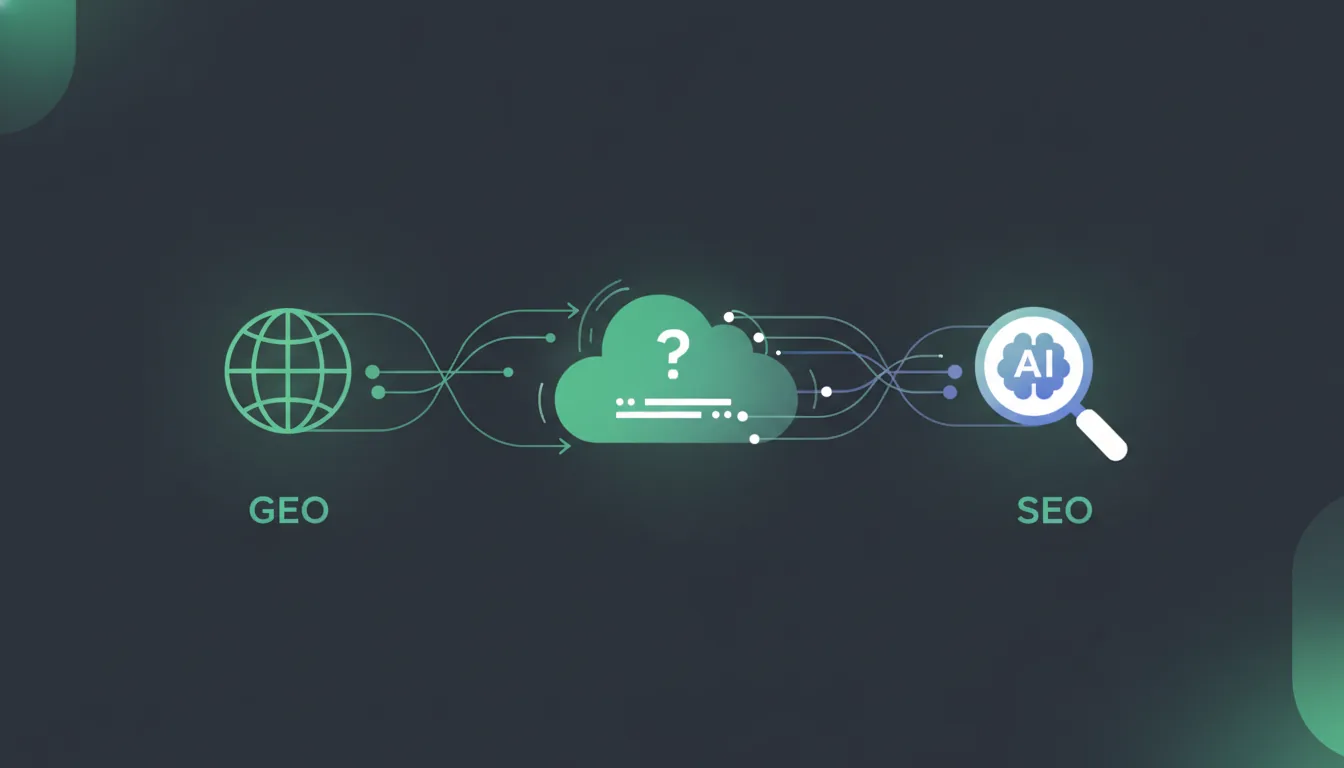
GEO vs SEO: what changes when AI answers the question
Search gave you a list of ten links. An AI gives one paragraph with room for three names. You are no longer competing for placement, but for inclusion.
Search used to give you a list. You typed a query, you got ten links, and your job was to be one of them. Ask ChatGPT the same question today and there is no list. There is one answer, written in prose, that mentions two or three companies and quietly omits everyone else.
That is the whole difference, and it is bigger than it looks. SEO is a competition for placement. GEO is a competition for inclusion. You are not trying to rank above someone anymore. You are trying to exist in a sentence that has room for three names.
What GEO actually stands for
GEO means Generative Engine Optimization: making a brand more likely to be mentioned, and correctly described, in the answers that generative AI systems produce. The term comes from a research paper by a group at Princeton and the Allen Institute, and it stuck because the industry needed a word for a problem that suddenly existed.
It has nothing to do with geography. You will find blog posts, including some that used to be on this one, that use "GEO" to mean local SEO, Google Business Profiles and map results. That is a different discipline with an unfortunate acronym collision. When we say GEO, we mean generative engines: ChatGPT, Claude, Gemini, Perplexity.
What genuinely stays the same
Start here, because the panic is overdone. Generative engines are not built on a separate internet. They read the same web you have been optimizing for years, and the plumbing still matters:
- Crawlability. If a machine cannot fetch your page, it cannot use it. This is still the first thing to check.
- Clear, structured content. A page that states plainly what a product is, who it is for and what it costs is easy for a model to reuse. A page that buries this under three paragraphs of positioning language is not.
- Being talked about elsewhere. Models learn about you from the whole web, not just your site. Documentation, forums, review sites, press, comparison articles written by other people.
If your SEO fundamentals are sound, you have not wasted the last decade. You have a head start.
What actually changes
There is no position to hold
Rankings do not exist here. An answer either names you or it does not. There is no page two you can climb from, and no incremental progress you can report to a board: you go from absent to present, and the step in between is invisible.
The same question does not give the same answer twice
Language models are probabilistic. Ask the same thing twice and you can get two different lists of recommended vendors. This is not a bug you can optimize away, and it has an uncomfortable consequence: a single check tells you almost nothing. One answer is an anecdote. A pattern across many answers, repeated over time, is data. Any measurement approach that does not account for this is measuring noise.
Being mentioned and being cited are different things
A model can describe your product accurately, at length, and never link to you. Perplexity will show its sources inline; ChatGPT with browsing enabled sometimes will; a model answering from what it absorbed during training will not, because there is no source to point at. Both outcomes matter, and they are not the same outcome. You can be extremely visible and get no traffic at all: that is precisely why measuring this with a traffic tool tells you nothing.
Your competitors are not who you think
The most useful thing generative engines reveal is who they name instead of you. It is frequently not the competitor you benchmark against. Models cluster brands by how the web talks about them, not by how your market map is drawn.
It breaks by language
This is the part that surprises people who export. Visibility does not travel. A brand that a model recommends confidently in English can be entirely absent from the same question asked in German, because the German-language web says less about it. There is no "global" answer to check. There is one answer per language, per market, and the gaps between them are where the money is.
How to actually check where you stand
Three things you can do this afternoon, without buying anything.
Check whether you are blocking the crawlers. Open yourdomain.com/robots.txt and look for GPTBot (OpenAI), ClaudeBot (Anthropic), PerplexityBot and Google-Extended. A Disallow: / under any of them means you have opted out of that system's ability to read you. Plenty of sites added these rules during the AI scraping panic and never revisited the decision. It is worth knowing which side of that line you are on, and choosing deliberately.
Ask the questions your buyers ask. Not "what is [your brand]", which tells you nothing, because the model will find something to say. Ask the questions someone asks before they know you exist: "what's the best tool for X for a mid-sized company", "who are the main suppliers of Y in Europe", "compare the leading options for Z". Then read who gets named. That absence is your real position.
Ask them again in every language you sell in. Translate the same question into German, French, Spanish, Italian, and run it again. The delta between your home market and your export markets is usually the single most actionable number you will find, and almost nobody looks at it.
Where a tool becomes necessary
You can do the above by hand once. You cannot do it repeatedly, across dozens of prompts, four platforms and five languages, and still have a job. That is the point where measurement has to be automated, and it is what PSentry does: it runs your prompt set across ChatGPT, Claude, Gemini and Perplexity, in each language and market you operate in, and reports where you are named, where you are cited, and who is named in your place.
Two honest caveats, because the category is full of people who will not give them to you. The cadence sits at twice a month rather than continuously, because a brand's standing inside these systems moves on the timescale of the web being rewritten, not the timescale of a refresh button, and polling faster would only report the same noise more often. And nothing about the tool touches what a model actually says: there is no editing pass, no back channel, no version of this that pushes an output one way or another, whatever a rival's pitch deck implies. What it hands over is where you actually stand, country by country and language by language, the scoreboard this whole comparison has been asking you to check.
The honest summary
GEO is not a replacement for SEO and it is not a rebrand of it. It is a second scoreboard, one you are already on and have not been reading. The brands that will do well here are not the ones that find a trick. They are the ones that find out, in each market, what the machines are currently saying about them, and discover, usually with some discomfort, that it is not what they think.
Frequently Asked Questions
Is GEO going to replace SEO?
No. They optimize for different outcomes and they coexist. Search engines still send the majority of referral traffic to most sites. The mistake is not choosing one: it is measuring only the one you already know how to measure.
Does GEO mean local SEO?
No, and this is a genuinely common confusion caused by the acronym. GEO means Generative Engine Optimization. Local SEO (Google Business Profile, map packs, proximity) is unrelated.
Can I make an AI recommend my brand?
Not directly. There is no submission form and no ranking factor to tune. You influence what models say only in the way you always have: by what exists on the web about you, and how clearly it is written. Anyone selling you guaranteed placement in AI answers is selling you something they cannot deliver.
Why do I get a different answer every time I ask?
Because these models are probabilistic by design. This is why a one-off check is worthless and why measurement has to be repeated across many prompts and over time before it means anything.
Which platforms should I be watching?
ChatGPT, Claude, Gemini and Perplexity cover the overwhelming majority of real usage today. They behave differently: Perplexity retrieves and cites live sources, while others lean more on what they absorbed in training, so a brand's visibility can vary sharply between them.
I only sell in one country. Does the language part matter?
Less, but not zero: buyers research in English even in non-English markets. If you export, it is the whole game: your visibility in each destination market is independent, and it is normally much worse than at home.